

Field Research
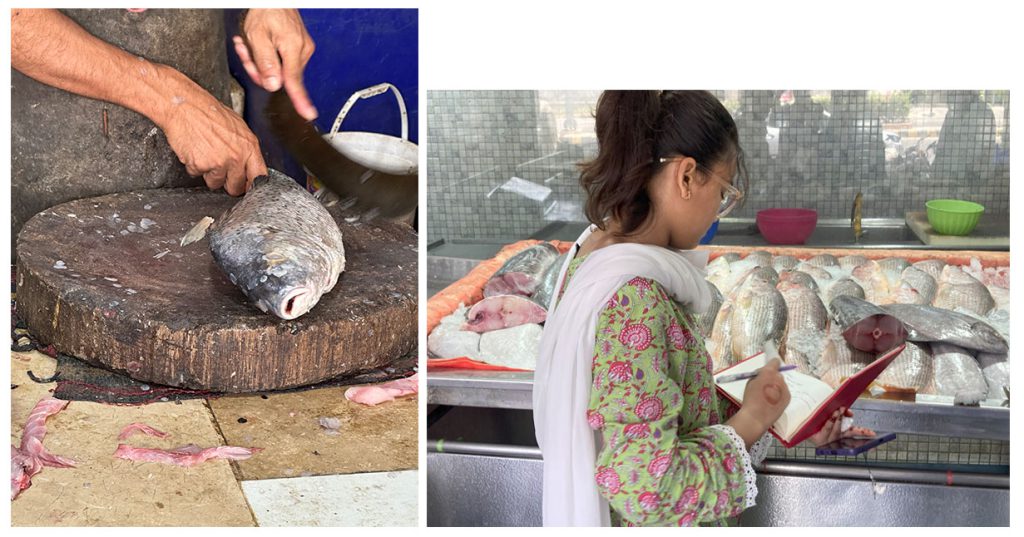
For the duration of two and a half months in 2025, the URA organized an internship program with students from the Department of Fine Art at IVS. A recurring activity of the internship was to collect data and surveys of the various fish markets in Karachi. The intention behind asking art students to learn about fish species through their anatomical differences with fishermen at the bazaar, who are involved in deboning/deveining, cleaning and filleting of seafood, is to learn through the cycle of consumption and preparation how our fishing economy works directly through its stakeholders. This field research has allowed the URA and our students to have a better grasp of the biology of fish and crustacea, the technical requirements of fishermen and how mass development, migration, climate change and overfishing is affecting Karachi’s seafood economy. The field research aspect under the Machi Qaida project, was designed out of both curiosity and concern; First, that fish is not a popular food choice among the citizens of Karachi, despite the city’s close proximity to the sea. Second, that in recent years there has been a notable rise in malpractices within the export of fish, including large international trawlers posing a serious threat to the seabed through destructive fishing methods, as well as fishing during off-seasons. Through fieldwork, the URA was able to understand the complexity of these issues and find ways to creatively address them.
Tracking and Mapping
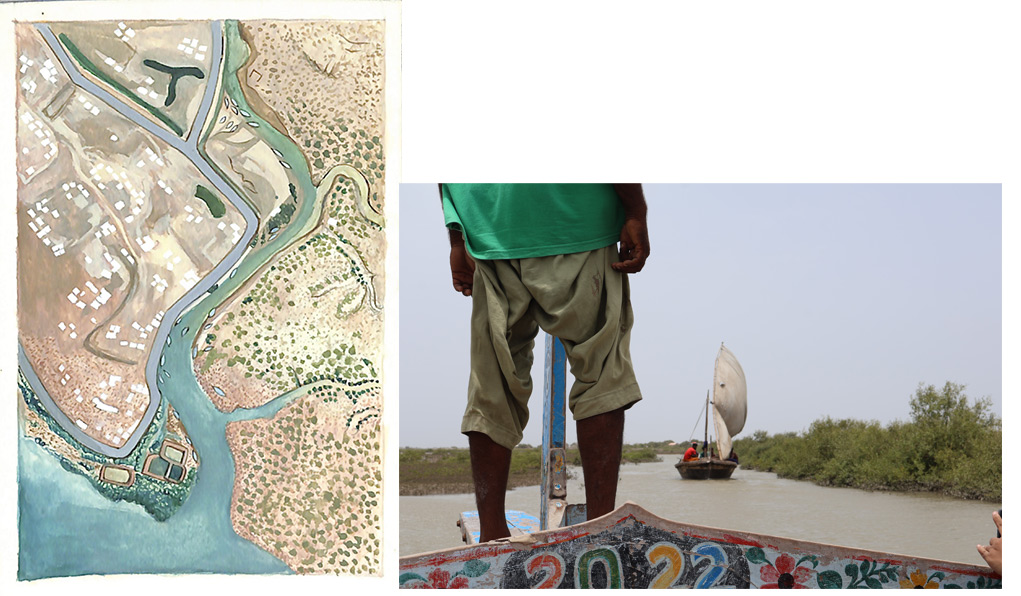
As part of our field research, the URA was hosted and supported by WWF Pakistan at Keti Bandar to learn about how fishermen within the deepest parts of the Indus Delta, are adapting to severe extremities in their environments and the impact this has had on residents’ livelihoods. We were taken along the Hajamro Creek, which used to be the main artery connecting the Indus Delta with the Arabian Sea, before the River Indus shifted its course. This illustration of Hajamro Creek is executed by URA intern Eesha Adil, and is an interpretation of the boat ride: “In the middle of the boat ride around Keti Bander, we opened up Google Maps to see ourselves floating right at the edge of the Indus Delta, at the cusp of the Arabian Sea. I switched to satellite view and began tracking our journey; The screen showed a scattering of mudflats, winding creeks, and strange shapes that didn’t quite make sense until I looked up from the boat. At that moment I wanted to understand the geography better so I took screenshots of the area focused on Hajamro Creek. This illustration is based on what we saw. It includes mangroves, flooded ponds, patches of saline land near the huts, boats docked along the shore, and the large open mudflats that only can support certain limited plants.”
Archival Research
One of the most exciting aspects of the Machi Qaida project is our archival research into public and private collections. The URA has been documenting historical and contemporary responses on fish species, anatomical drawings, Sindhi boat-building and decoration vernacular, as well as pre-existing maps of Karachi’s expansive urban development which proliferated in conjunction with the city’s maritime ventures. With the support and encouragement of institutions and individuals such as the Sindh Wildlife Museum and the Furqaan Ahmed Collection, the URA has the privilege to to view, physically handle and record materials, which pertain to the many tangents of the Machi Qaida. Understanding that we live in an increasingly digital world, the URA interns over the summer of 2025, took the initiative to start digitizing handbooks, news articles and journals in limited print quality which shed light on the region’s marine biology, tourism efforts by the government and other NGO’s, as well as infrastructure records that have links with the fishing industry. By making connections and incorporating information ranging from statistics to hand-drawn motifs within an ever-growing database, the Machi Qaida archives continue to help the URA in looking at the diversity and challenges of the fishing industry in Karachi.
Left: Sindh Wildlife Museum Library Right: The Furqaan Ahmed Collection.
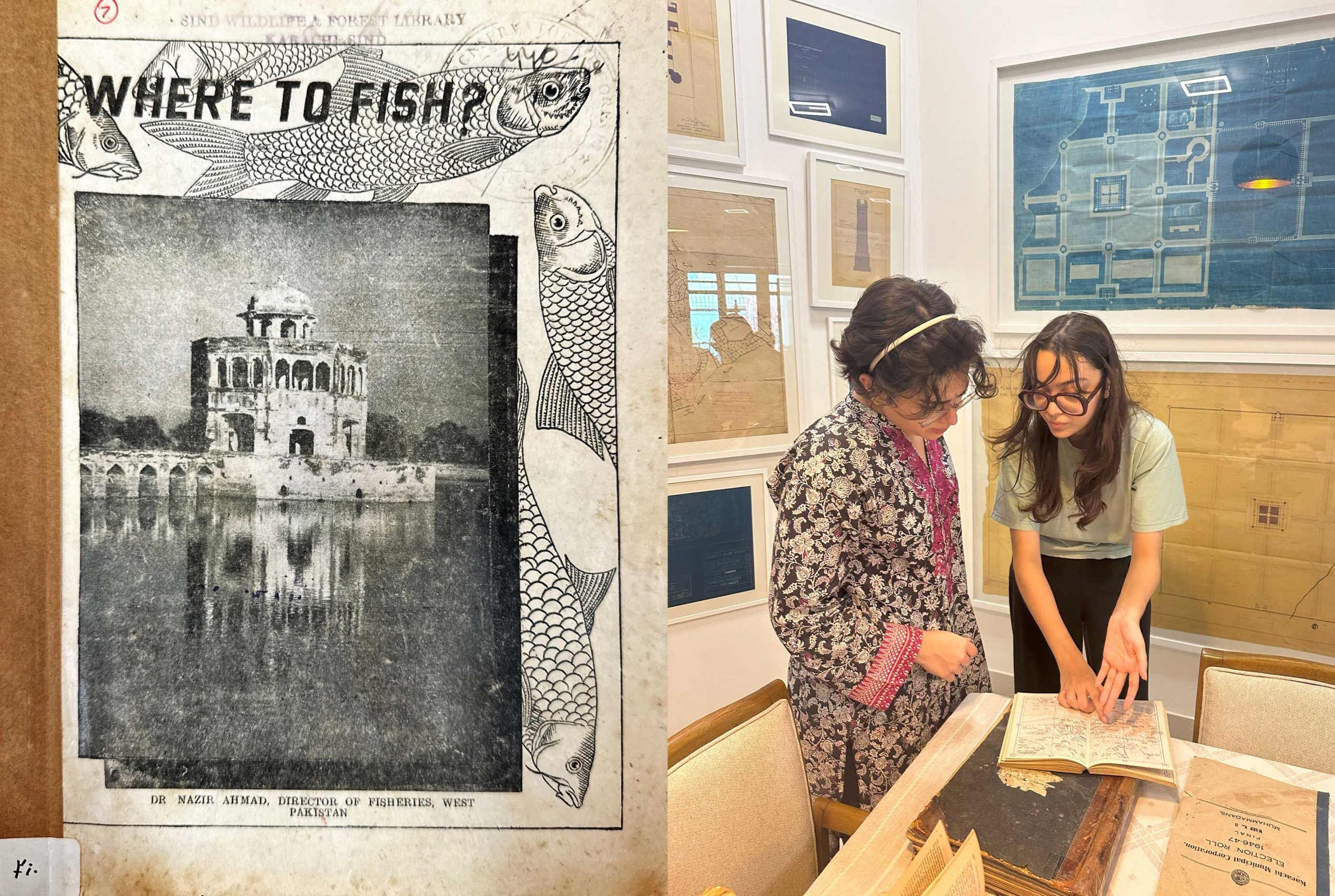
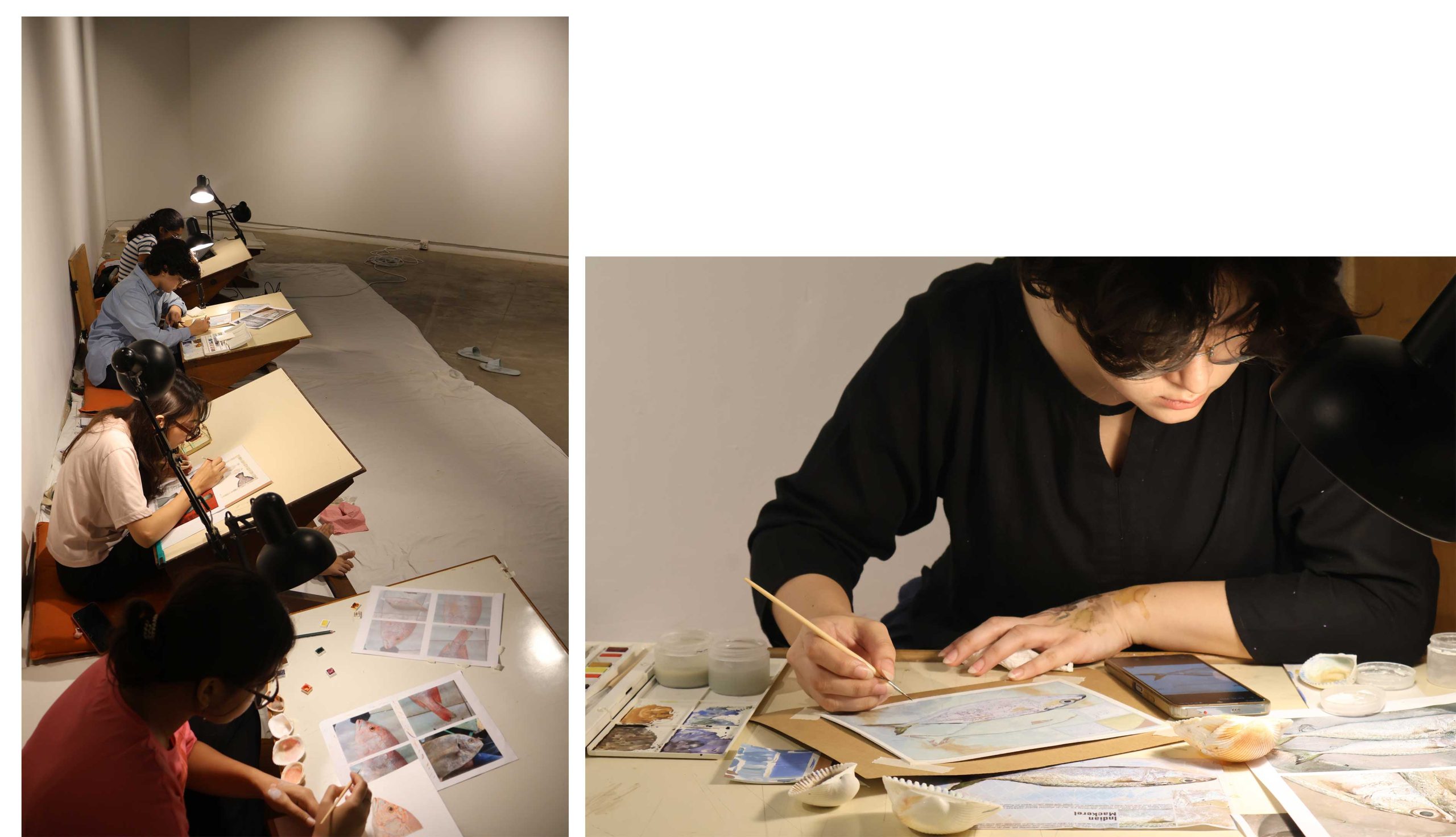
Illustration Workshops
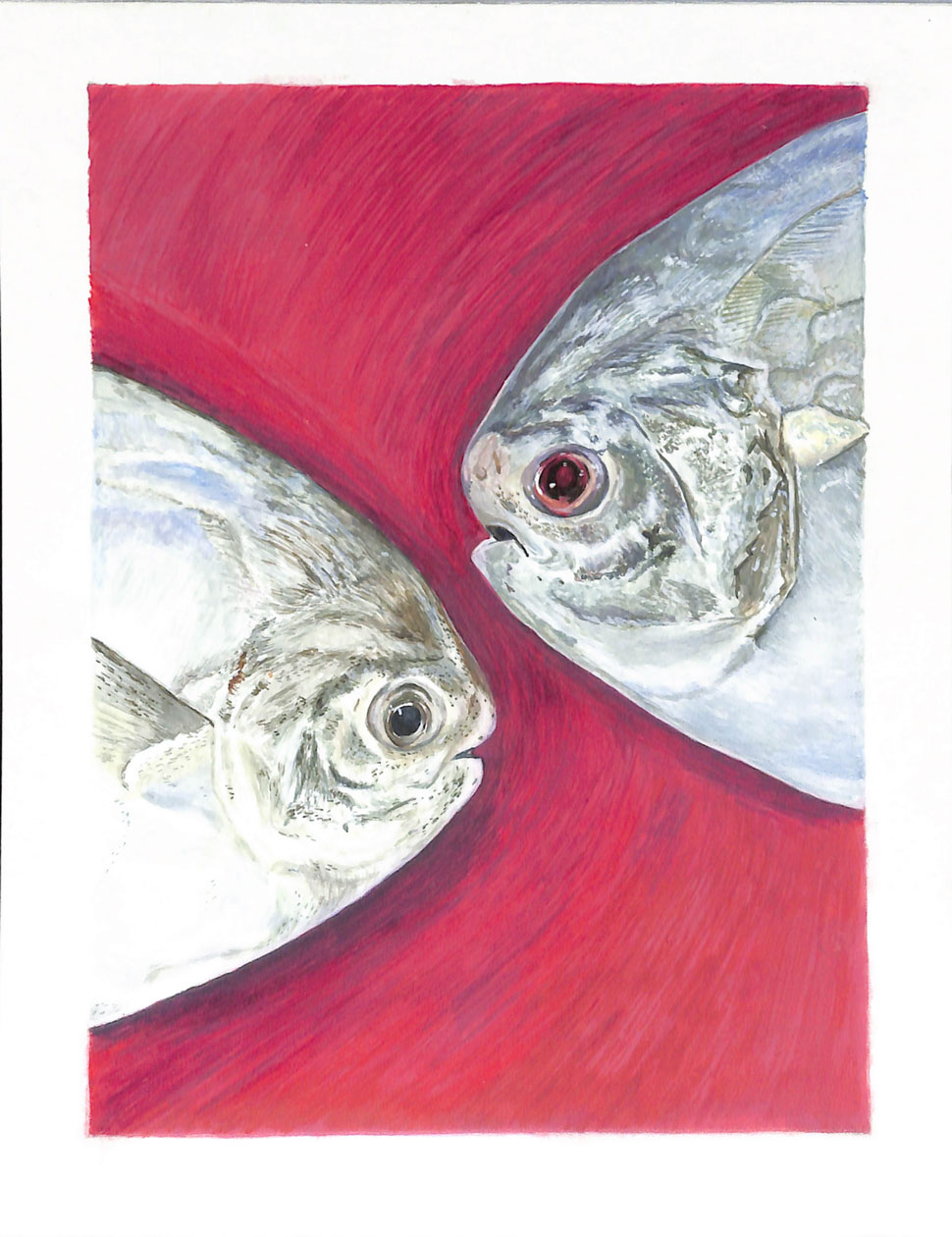
Detailed drawings and renderings of animals, humans, flora and fauna are generally a hallmark of ‘South Asian’ traditional painting. Naturally over the decades, techniques and materials in miniature painting have had to adapt and the URA integrates these changes in art into the Machi Qaida by conducting contemporary illustration workshops under the supervision of artist and miniature painting specialist. Muzammil Khan. While a qaida relied on communicating through highly-realistic photographs or paintings, in this project, students were encouraged to use historical manuscripts and paintings as references but respond with compositions which reflected the nature of their research. Exploring various techniques translating images into 2D drawings, their focus in the Machi Qaida workshops are on producing intricate visual representations of materials, markets, community interactions and key ecological issues. These workshops are included in the Machi Qaida project, to provide learning experiences and skill-sets to URA interns.